AI Agents as Force Multipliers: Why Developers Are More Valuable Than Ever
Sep 18, 2025 · 2 min read
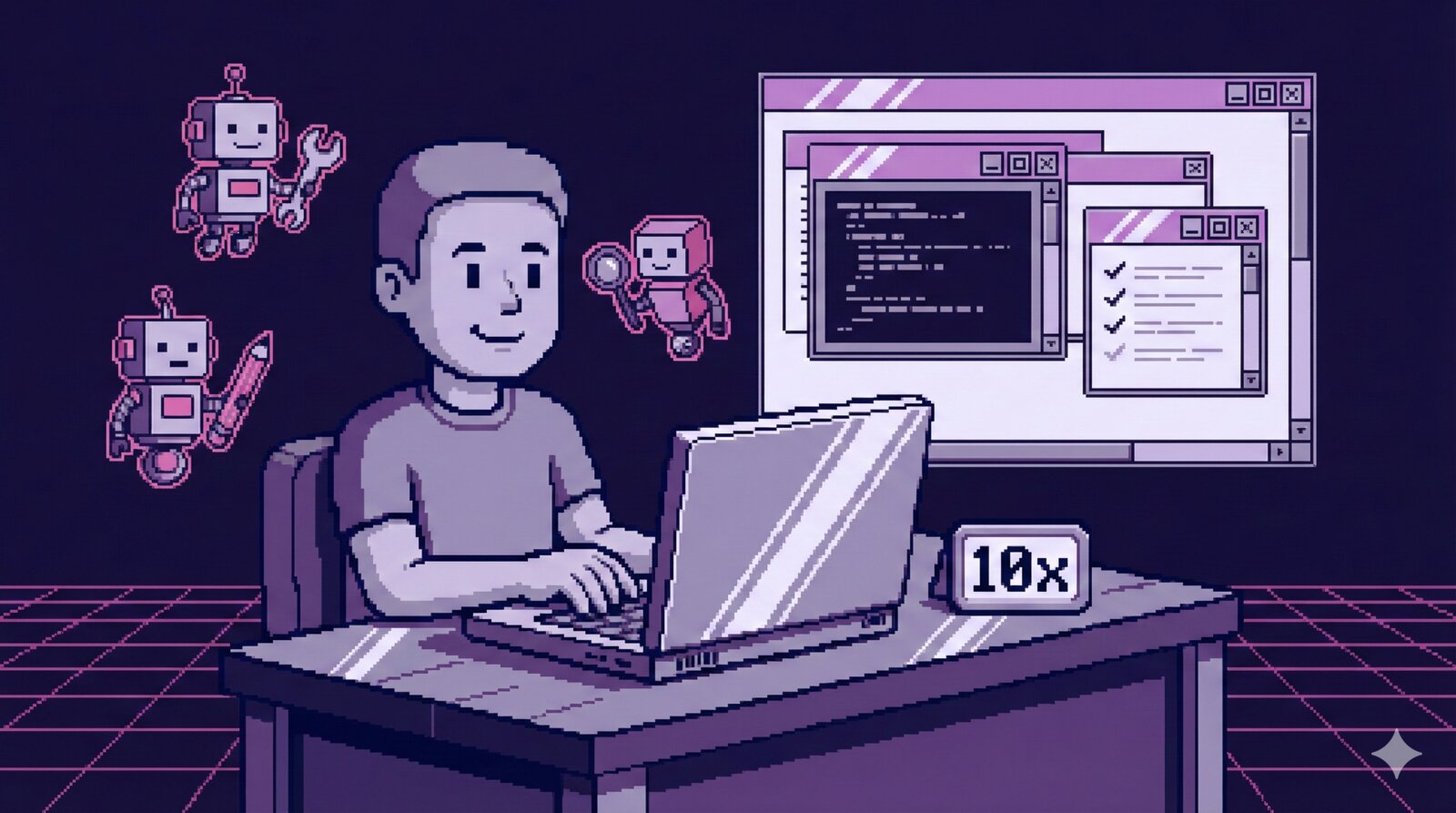
Unpopular opinion: AI coding agents are making developers worse, and I love it.
I can’t imagine coding without AI agents anymore. Honestly, I’d be bored out of my mind. Yes, I love playing with these tools, and if I lose some low-level skills along the way, so be it. I’ve lost plenty of skills before (who remembers Arduino assembly or advanced calculus from university?).
The part most people miss: developers aren’t going anywhere. They’re becoming more valuable.
The Expertise Paradox
These AI tools are practically useless for serious software development unless you already have deep technical expertise. What I’m really doing is leveraging my entire career to become more productive.
The code these agents produce? Often garbage. And you’ll hit a wall fast without an architect’s mindset.
I’ve watched junior developers struggle with AI tools in ways that senior engineers don’t. The difference isn’t that seniors are better at prompting. It’s that they know:
- What questions to ask
- What architecture makes sense
- When the generated code is subtly wrong
- How to debug the inevitable issues
Force Multipliers, Not Replacements
The truth is:
→ AI agents are force multipliers, not replacements → They amplify what you already know → They can’t substitute for system design or architectural decisions
This isn’t like calculators replacing arithmetic. It’s more like power tools replacing hand tools. You still need to know carpentry to build a house, but now you can build faster.
A 2024 GitHub study found that while AI coding assistants increased completion speed by 55%, the quality improvements were most pronounced for experienced developers who could better evaluate and refine the output.
The New Developer Skillset
So while I’ll keep using these tools (and loving the productivity boost), the fundamentals of software engineering matter more than ever. AI just helps us focus on what truly requires human expertise:
- Understanding the problem deeply (AI can write code, but it can’t know what should be built)
- System design and architecture (the 30,000-foot view that makes or breaks projects)
- Code review and quality judgment (knowing when AI output is good enough vs. dangerous)
- Debugging complex issues (AI-generated bugs require AI-augmented debugging skills)
- Business context (why this feature matters, what tradeoffs are acceptable)
Who Will Survive the AI Transition?
The developers who thrive will be the ones who know enough to make AI actually useful. Not the ones who resist it, and not the ones who blindly trust it.
This means investing in fundamentals even as the tools change. Understanding data structures, system design, and architectural patterns matters more than memorizing syntax, because now the syntax is cheap but the thinking is valuable.
Practical Takeaways
If you’re wondering how to position yourself:
- Double down on architecture and design (this is what AI can’t do well)
- Learn to evaluate AI output critically (develop a nose for AI-generated code smell)
- Focus on communication skills (explaining technical decisions to stakeholders becomes more valuable when implementation is faster)
- Embrace the tools (early adopters gain compound benefits, and the gap only widens)
- Keep building real things (the best way to learn AI’s limitations is to hit them)
The future belongs to developers who view AI as a power tool, not a threat. Those who learn to wield it effectively will accomplish things that would have taken teams years to build.
What’s your experience? Are you finding AI agents amplify your expertise, or exposing gaps in your fundamentals?
More Thoughts
AI Adoption in Legal Tech: What I Learned at a Legal Conference
Jul 18, 2025 · 3 min read
I walked into a legal conference ready for some serious eye-rolls about AI. Boy, was I wrong. The legal industry is …
Read more
Panel of Experts Prompting: Using AI Like a Boardroom, Not an Intern
May 25, 2025 · 2 min read
Most people prompt ChatGPT like it's an intern. Here's a technique to use it like a boardroom of experts, and get …
Read more
Django in the LLM-Native Era: Why It's the Perfect AI-Friendly Framework
May 18, 2025 · 3 min read
Django's conventions, batteries-included approach, and 20-year codebase make it ideal for AI-assisted development. …
Read more
AI Vibe Coding: Why I Let AI Write Both My Code AND Tests
Apr 18, 2025 · 3 min read
I let AI write both my code AND tests, and the results demolished my expectations. Here's how AI-generated tests …
Read more