The Company Brain That Runs My Company
Oct 16, 2026 · 6 min read
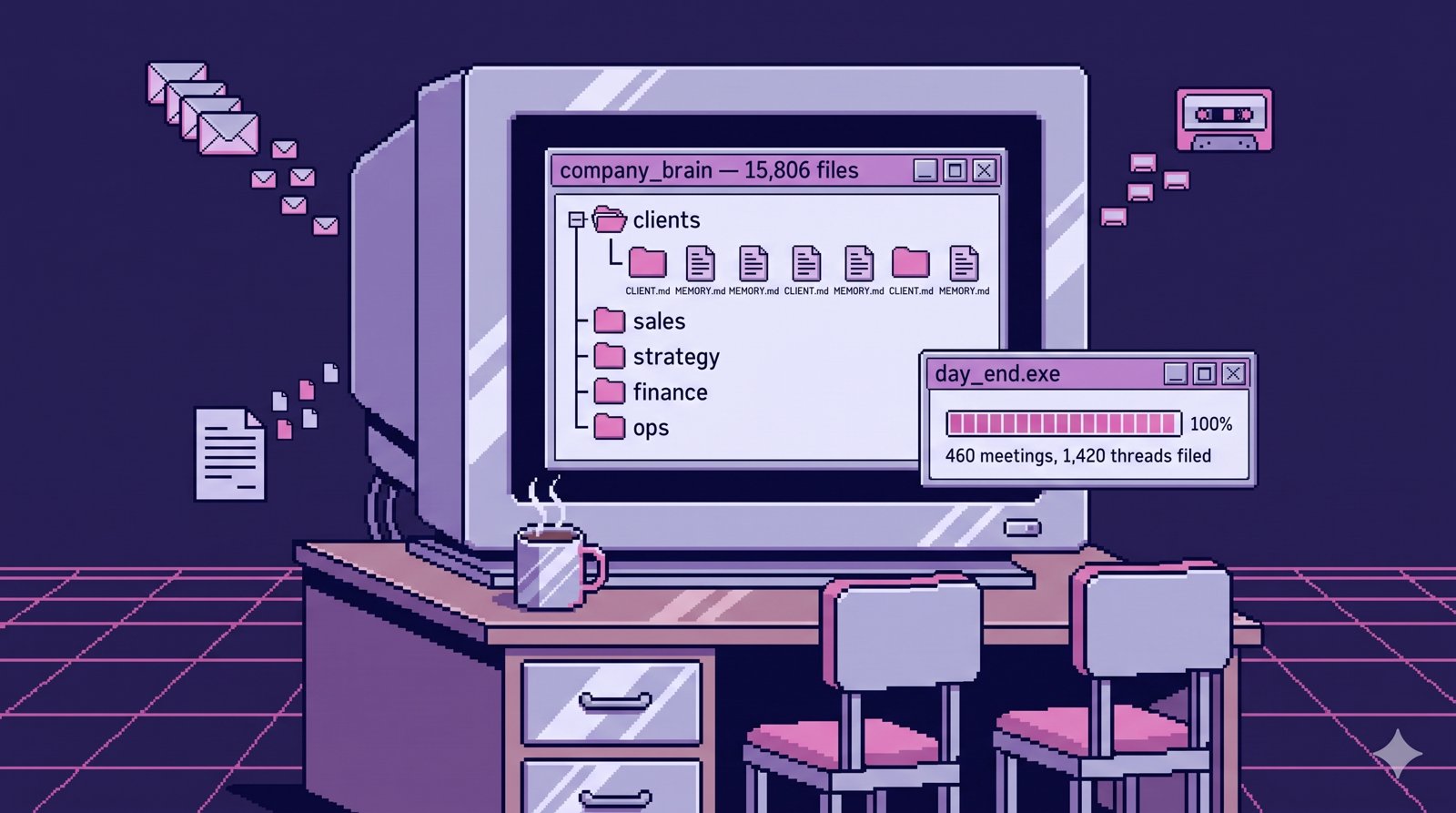
My company runs on one git repository. It holds every client folder, every call transcript we’re allowed to keep, a few thousand email syntheses, and a set of Claude Code commands that read all of it. When my co-founder asks “what did we promise this client about hosting?”, the answer comes back with a link to the email or the transcript line where we said it. That repository is what I mean when I say “company brain,” and this post walks through what is in ours, how it grew, and which parts still don’t work.
I’m writing this down because “second brain” has turned into a marketing phrase, and most of what gets sold under it is one person’s notes app with a chatbot on top. That is useful. It’s also a different thing from a system that two founders, a handful of engineers and a rotating cast of contractors all lean on at once.
What’s in the folder
The layout is boring on purpose. Every client gets a folder at clients/<firm>/<engagement>/. Inside: a CLIENT.md with contacts and context, a MEMORY.md that acts as a rolling relationship memory, syntheses of emails and meetings, a machine-generated index, and a references/ folder with the raw transcripts and emails. There are about 65 live firm folders right now (three of them internal projects) and 34 archived ones.
Next to clients/ sit the departments: sales, project management, finance, strategy, marketing, ops, automations. A lib/ folder holds 41 shared Python libraries for things like branded email and PDFs. All of the Claude Code tooling lives in one .claude/ folder at the root: 67 commands, 85 skills, 18 agents and 27 guides.
The brain itself is mostly markdown. Out of 15,806 tracked files, 6,010 are markdown, including 727 transcripts and 1,295 emails. Claude reads those files the same way a new hire would, starting from the 21 CLAUDE.md files that explain each part of the repo. The root one started at 58 lines in March and is 223 lines today, and every one of those lines is there because something went wrong without it.
How things get in
A brain that depends on someone remembering to paste things into it stays empty. Ours is fed on a schedule. About a dozen Cloud Run jobs sync email three times a day, pull meeting transcripts every hour, post standups and check time logs. Transcripts go through a confidentiality gate before they touch the repo, and I learned why that gate has to be a required check the hard way (the day 46 transcripts reached main).
The other half is a command each founder runs at the end of the day. /strategy:day-end-process is about 1,100 lines of instructions plus nine guides and six agents. It reads the day’s meetings and email, files what matters into the right client folder, drafts replies (as drafts, never sent, for reasons), proposes tasks, suggests doc edits and captures lessons.
Between June 4 and September 30 it ran 39 times across two founders. In that window it processed 460 meetings and 1,420 email threads, surfaced 626 threads where someone owed a reply, made 303 doc edits, synced 270 contacts and researched 57 companies. It also created 1,042 tasks, which was far too many, and fixing that took a script rather than a better prompt (the full story).
How it grew
It didn’t start as a brain. In late December 2025 I wrote a few business commands: one to verify docs, one to find gaps in a proposal, one to synthesize a client’s emails. On March 5, 2026, I pulled the scattered projects into one monorepo. The next day I consolidated every workspace’s .claude folder at the root and archived 21 stale projects, then 7 more, then un-archived 4 when it turned out people still used them.
On May 1 all client work moved into clients/<firm>/<engagement>/. That one reorganization was followed by about ten commits fixing broken paths, which is the real cost of restructuring something that a lot of automation reads. The same day we deleted 12 project-management commands nobody ran and a 23-template email skill (we’ve deleted 52 skills and commands so far).
June brought the six-agent day-end pipeline and rules for where files are allowed to live, enforced by a hook that checks paths before Claude writes. July added the knowledge layer: a log of rulings, a learnings store, a small wiki and managed search. August through October has been mostly reliability work, which is less fun to write about and more important.
The repo has 3,474 commits and pull requests past #685. The large majority were co-authored with Claude, across about ten model versions. Commits peaked at 550 in March, the month of the big consolidation.
Team brain versus personal brain
This is the part that separates a company brain from a personal one, and it’s where most of the design effort went.
Claude Code keeps a private memory per user. When we started logging company rulings in July, six of the first ones were copied straight out of one person’s private memory files, including the rule that the AI never sends client email. Those rules had been governing that person’s sessions and nobody else’s. Anything a team depends on has to live somewhere the whole team reads, with a history, so now rulings go in one append-only log.
Two founders also means two mailboxes, two calendars and the same client meeting showing up twice. Without coordination, both day-end runs would file the same transcript and mint the same tasks. The fix was a shared coverage table with keys that match across accounts, plus one hard rule: my partner filing an email does not cancel my obligation to answer it (details here).
Then there’s the setup problem. People on the team have very different technical backgrounds, so in July we made a ruling: anyone using the brain needs git, Claude Code, uv and the shared environment file, and nothing else. Heavy work runs remotely. That ruling killed a local semantic search setup that needed about 2GB of models on every machine. We also rejected an option where every search query was a paid model generation. We ended up on Vertex AI Search, which only does retrieval, costs somewhere between $0 and $6 a month, and indexed 1,365 documents. On two of our three test queries, plain grep found nothing at all, which settled the question of whether search was worth adding.
People also leave. A team brain has to know who has access to what, so the repo keeps an access registry with 40 pages, one per platform, and CLAUDE.md tells Claude to ask about updating it whenever a new tool or credential comes up in conversation. When two contractors left this month, the offboarding was a checklist against those pages instead of an exercise in memory.
What doesn’t work yet
Plenty. We built an estimate calibration engine that is supposed to learn from estimates versus actuals. It has zero rows of actuals. We built a hook to track which skills get used. Its log file has zero lines. Collecting the data turned out to be the hard part, and I wrote about that in three feedback loops that collected nothing.
We tested a knowledge graph properly and killed it, because two identical runs agreed on only 16% of node labels (the test). And the tools feeding the brain lie in small ways: transcription that hears a person’s name as a common word, a notes tool that returned a months-old meeting byte for byte, a Notion integration that couldn’t see 19 of 36 databases for months without anyone noticing (a list of them).
None of this makes the brain less useful day to day. It does mean the honest pitch for a company brain is “it answers questions about your company with sources,” and the claim that it compounds on its own needs a lot more evidence than I’ve got.
If you’re starting one
Start smaller than this. One folder per client, email and transcripts syncing in on a schedule, one log for decisions, and a CLAUDE.md that tells the AI where things are. That alone answers most of the questions people actually ask. Everything else in this post got added because a specific thing broke.
If you want one of these for your team, I build them in 14 days.
More Thoughts
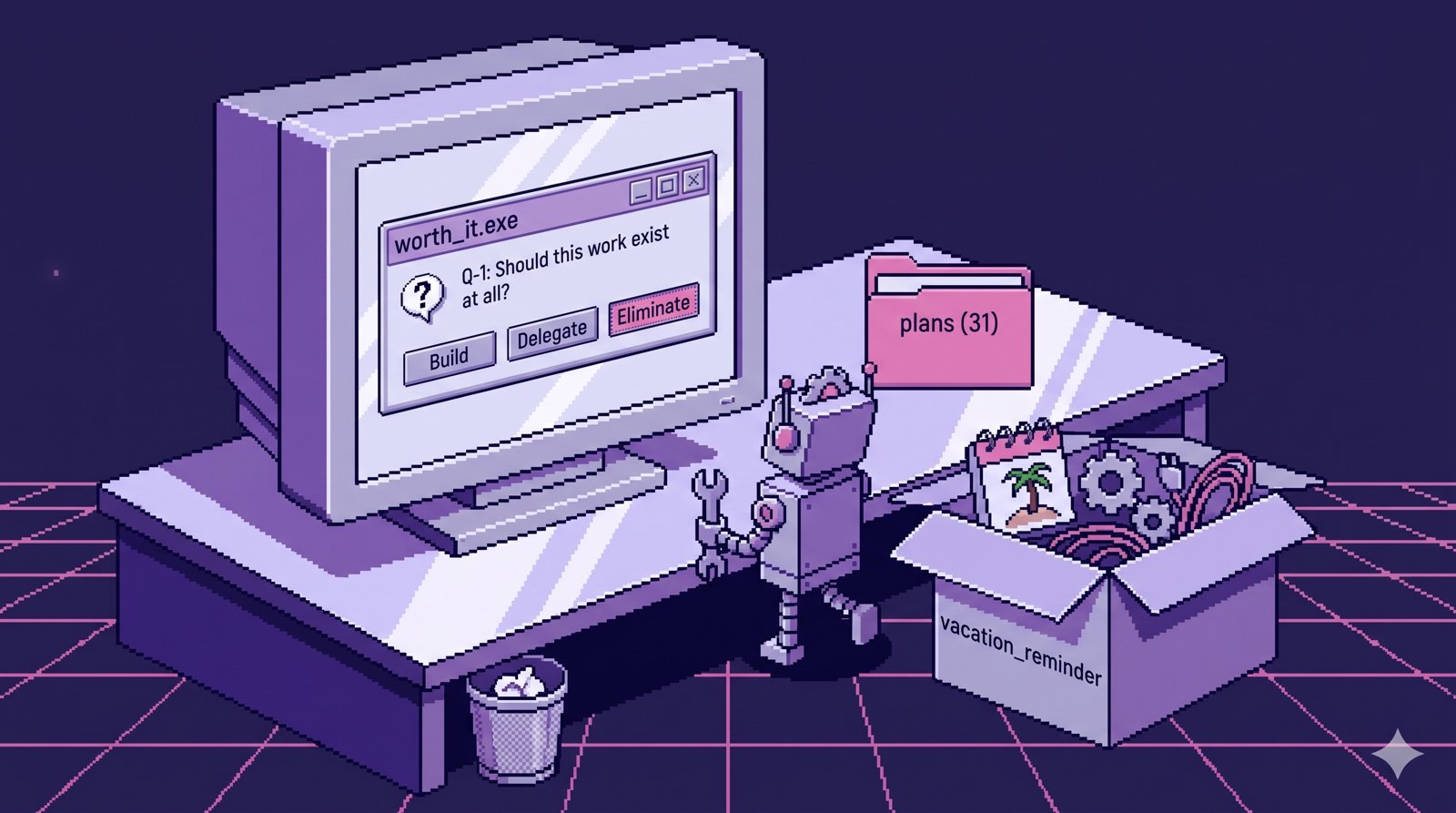
Before Automating Something, Ask Whether It Should Exist
Oct 16, 2026 · 6 min read
The first verdict our build gate ever gave was DON'T, for a vacation reminder job. It got the right answer by asking the …
Read more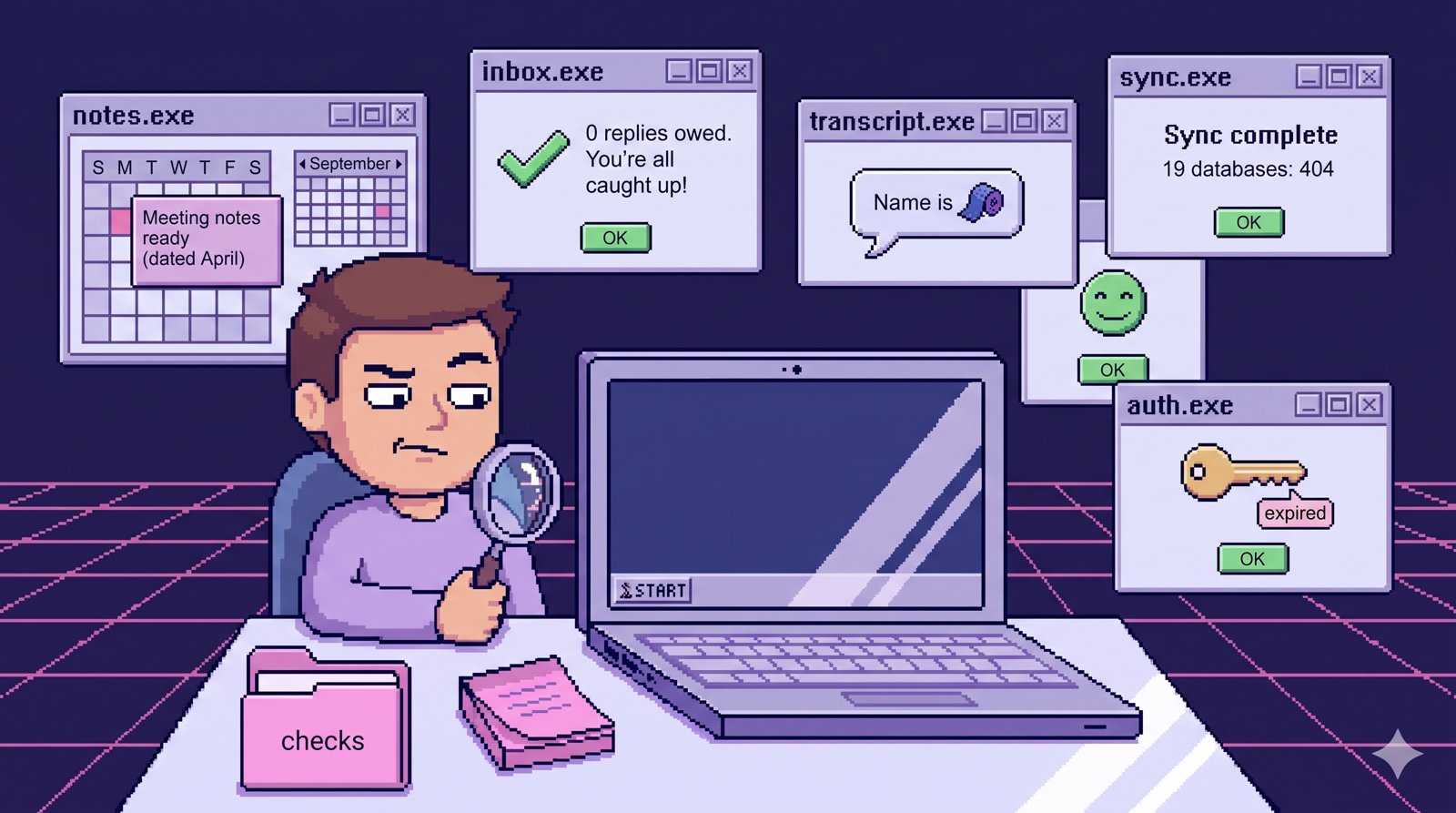
Eight Small Ways Our Tools Lied to the Brain
Oct 16, 2026 · 5 min read
The tools feeding our company brain broke it more often than the model did: transcription, email, notes and auth kept …
Read more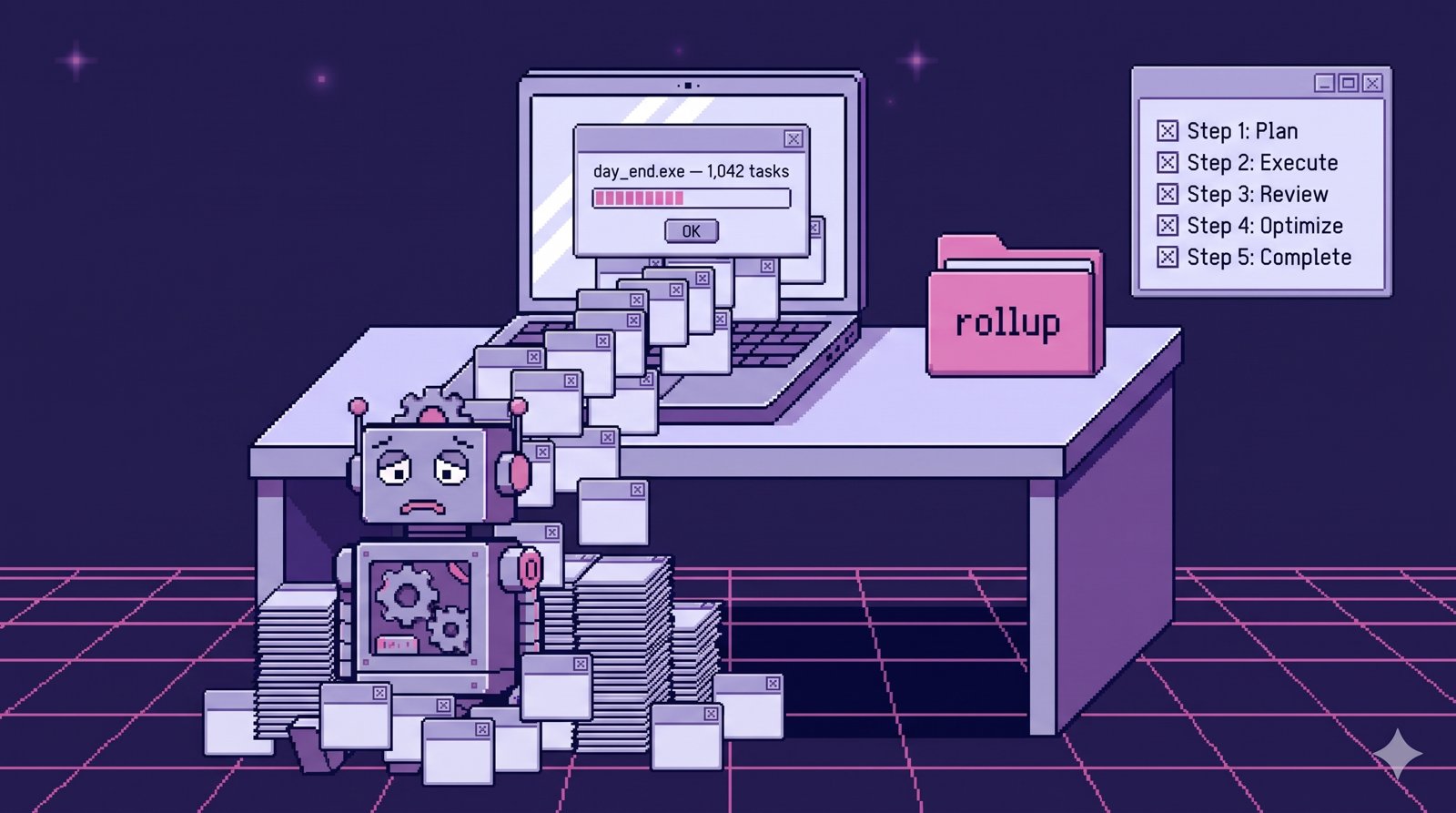
Our AI Created 1,042 Tasks in Four Months
Oct 16, 2026 · 6 min read
Between June and September our company brain created 1,042 tasks from our email and meetings. Most of them were noise. …
Read more
Our AI Drafts Every Email and Sends None of Them
Oct 16, 2026 · 5 min read
In four months our company brain surfaced 626 email threads where we owed a reply, and it can draft any of them. It …
Read more