Custom GPT for Your Business: 20 Files, Frozen the Day You Upload Them
Oct 17, 2026 · 6 min read
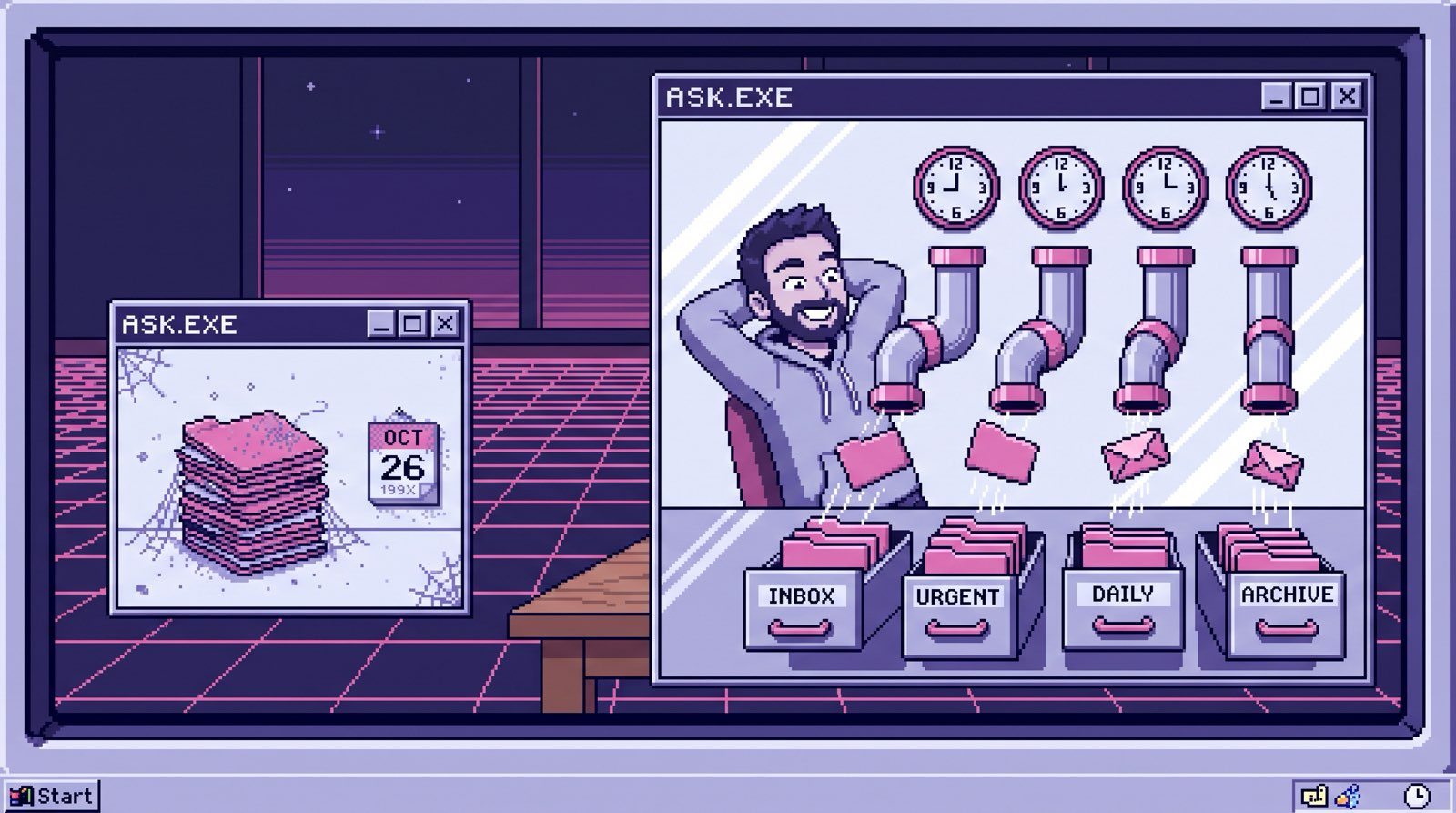
A custom GPT is a fine choice for your business if one person uses it and it answers from a handful of documents that rarely change, like a rate card, a handbook or a style guide. It starts failing once a whole team depends on it. The files are a snapshot from the day someone uploaded them. Answers don’t point back to a source unless you write that into the instructions. And everyone the GPT is shared with reads the same files, so you can’t give the sales lead and the new contractor different views.
One more thing, as of October 2026: OpenAI has scheduled custom GPTs to retire on December 11, 2026, and is moving them to plugins. A GPT’s knowledge files get copied into the plugin as reference files, so the same tradeoffs come along for the ride.
I run my company on a company brain built in a git repository with Claude Code. Below is where a custom GPT is enough, where it broke down for us, and what “teaching AI your business” ended up meaning in practice.
What a custom GPT is (as of October 2026)
Per OpenAI’s help docs, a custom GPT is a set of instructions plus up to 20 knowledge files, each up to 512 MB. You can switch on web search, apps the user has connected, or actions that call APIs you define. A GPT can use apps or actions, but not both at once. Who you can share it with depends on your workspace settings, and personal accounts can no longer publish new GPTs.
Claude Projects work much the same way. You add files to a project’s knowledge, every chat in that project can use them, and on paid plans Claude switches to searching those files once they get too big to read all at once. So custom GPTs and Claude Projects share a shape: a person curates a pile of files, and the AI answers from the pile.
When a custom GPT is enough
If you’re a solo consultant and you want your proposal template, your rates and three writing samples in one place, a GPT (or its plugin replacement) is the right amount of tool. Nothing in that pile changes weekly, you’re the only one asking, and you already know which file every answer came from because you wrote all of them.
I wouldn’t hire anyone to build that for you. An afternoon with the instructions box covers it.
Where it breaks for a team
The files go stale
A knowledge file is frozen on upload day. Your pricing changed in September and a client said something important on Tuesday’s call, but the GPT still answers from the PDF someone uploaded in June. Nobody is assigned to re-upload, so nobody does.
Our brain gets fed on a schedule instead. A client email sync is scheduled for 9am, 1pm and 4pm Eastern on weekdays, and a job checks for new meeting transcripts every hour. Each founder also runs an end-of-day command that files the day’s meetings and email into the right client folder.
Scheduling breaks too. The hourly transcript job has opened 70 pull requests since it went live on September 28, all of them in shadow mode, and between them they would have filed exactly one transcript. Its confidentiality gate holds anything it isn’t sure about, and right now it isn’t sure about much. That is slow and a bit embarrassing. I still prefer it to a folder that silently ages, because I can see every one of those 70 runs and what it held.
Answers don’t come with sources
OpenAI’s own guidance says that if you want a GPT to cite uploaded content, you have to ask for it in the instructions.
On a team, the answer is only as useful as your ability to check it. When my co-founder asks what we promised a client about hosting, the brain answers with a link to the email or transcript line where we said it. Our pricing and scope rules show up in drafted proposals as a line naming the ruling ID and its date, so whoever reviews the proposal can see which rule shaped it. That line exists because a rule in our root CLAUDE.md says to print it every time.
Everyone sees the same pile
A GPT’s knowledge belongs to the GPT. Whoever can open it can ask about anything in those 20 files. That’s fine for a handbook. It’s a problem the moment you’d like to add a client contract, a salary band or a board deck.
We hit the mirror image of this problem. When we started logging company rulings, six of the first ones came out of one person’s private AI memory, including the rule that the AI never sends client email. Those rules governed that person’s sessions and nobody else’s (the full story). A team brain needs both a shared layer and rules about who reads what, including flags that keep a lesson from one client’s project out of another client’s documents.
Two people also means two copies of everything. Two founders get the same meeting invite and the same client thread, and without coordination both of us file it and both of us create the same follow-up task. Solving that took a shared coverage table (how we split the work), and it’s a problem a single-user GPT never has to think about.
Can I train ChatGPT on my own data?
Almost nobody who asks this needs training. Training changes the model itself, and it’s expensive and hard to undo. A custom GPT, a Claude Project and our company brain all leave the model untouched. They look things up.
The lookup is called retrieval, and it works like a new hire with a filing cabinet. A question comes in. Search pulls the few passages most likely to matter. Those passages get placed in front of the model alongside the question, and the model answers from them. If the right document isn’t in the cabinet, or search can’t find it, the smartest model in the world answers from nothing.
So the work goes into the cabinet and the search. Ours runs on Vertex AI Search over 1,365 documents for somewhere between $0 and $6 a month, and on two of our three test queries plain text search found nothing at all (the details). We also tried a knowledge graph on top and killed it after two identical runs disagreed on most of their labels (the test).
The model matters less than people expect. On one structured extraction job, a cheap model matched the frontier model at roughly a twentieth of the cost. We only found out because we tested both on the same documents before picking.
What teaching it your business looks like
It looks like writing things down where the AI reads them. Our repo has 21 CLAUDE.md files that tell Claude what each part of the company is and where things live. The root one is 223 lines, and every line exists because something went wrong without it. Rulings go in an append-only log. Each client gets a folder. Email and transcripts arrive on a schedule, and a person reviews what the AI files.
It’s the same stuff you’d hand a sharp new hire on day one, kept current by jobs instead of by whoever remembers.
If your team has outgrown its GPT
If you built a custom GPT and it’s already out of date, or you’re staring at the December migration and wondering whether to bother, I can build the team version for you. I connect one team’s email, docs, calls, spreadsheets and calendar, with access rules for each person, and it lives in accounts you own, so nothing is stuck in my login or a GPT store when we’re done. It’s from $1,997 for one team. Answers with sources by day 14, or all your money back.
More Thoughts
Claude Code for Non-Developers: Our Whole Team Installs Four Things
Oct 16, 2026 · 6 min read
Claude Code works for non-developers when the work is documents. Our team installs git, Claude Code, uv and one env …
Read more
Can Claude Read My Email? It Has Filed 1,200 of Our Threads
Oct 15, 2026 · 6 min read
Can Claude read your email? Yes, two ways: the Gmail connector in the app, or a scheduled sync into storage you own. …
Read more
The Company Brain That Runs My Company
Oct 14, 2026 · 7 min read
My company runs on one git repository that reads our email, call transcripts and docs, and answers questions with …
Read more
We Built Three Feedback Loops. None Collected Anything.
Oct 13, 2026 · 7 min read
In August we built three ways for our company brain to learn from its own work. Two months later, two logs are still …
Read more